U.S. and Japan Announce Plans for Okinawa Land Return

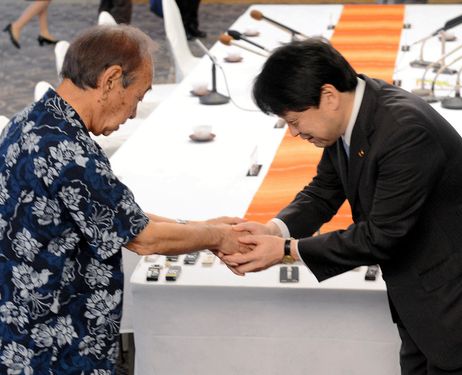
Okinawa Governor, Hirokazu Nakaima, meets Japan Defense Minister, Itsunori Onodera

Okinawa Governor (L), Hirokazu Nakaima, meets Japan Defense Minister (R), Itsunori Onodera.  Source: Asahi Shimbun.

On 5 April 2013, the U.S. and Japan announced an agreement on a consolidation plan that involves a timetable for the return of some 2,500 acres of Okinawan land and the transfer of 2,700 US forces stationed in Okinawa to Hawaii and Guam.  The consolidation plan is not new but originated from an earlier agreement reached in 1996 that called for a detailed plan by late 2012.   The plan arose from the furor surrounding the gang rape of an Okinawan school girl by American servicemen.  Moreover, the announced plan pushes back the moving of Futenma base by 9 years to 2022.

The agreement strengthens ties between the two countries, but it is not clear what the local Okinawan opinion is.  The governor of Okinawa, Hirokazu Nakaima, told reporters:

I think it is extremely good that the government is buckling down to deal in concrete terms with the return of the bases.  But it is hard to evaluate the plan until I have had a chance to consult with mayors of the affected communities.  (in The New York Times; emphasis added)

The Asahi Shimbun reported that Governor Nakaima noted that the announced plan was vague about when Futenma land would be returned.  He pointed out that the land would be returned “fiscal 2022 or later” provided that certain conditions were met.  [Note: See pages 17, 19, and 27 of the plan.]  On the day of the announcement some 120 protestors confronted Japan Defense Minister Itsurnori Onodera calling for the unconditional return of land under Futenma air station.

While the agreement sets 2022 as the target date for the return of Futenma base, it is contingent on a replacement air base being operational in another part of Okinawa. In short, one base is closed while another is created within Okinawa.  The proposed replacement base in Henoko has been criticized as being situated in valuable ecological site.

Sources

The New York Times, 4 April 2013, “U.S. and Japan Agree on Returning Okinawa Land” by Martin Fackler.

Pacific Business News, 5 April 2013, “U.S., Japan announce plans to move Marines from Okinawa to Hawaii, Guam” by Mark Abramson.

Huffington Post, 6 April 2013, “Okinawa Land Return Deal Reached Between Japan, U.S.” by Lolita C. Baldor.

The Asahi Shimbun, 6 April 2013, Okinawans blast vague plan to return land used by U.S. military.”
Okinawa Protests Japan’s ‘Restoration of Sovereignty Day’

Note: This posting is the first of the “After UTS III” series.  We want to continue the conversation that began at Uchinanchu Talk Story III.  We hope to bring to people’s attention recent news and developments affecting the people of Okinawa and so provide a forum for discussing our common concerns.


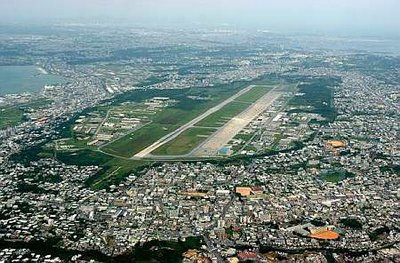
Futenma Base in the middle of Ginowan city

Futenma Base in the middle of Ginowan city


The Okinawan prefectural assembly recently passed a unanimous resolution rejecting the Japan government’s decision to celebrate “Restoration of Sovereignty Day.”  The Ryuku Shimpo commissioned a poll that found that approximately 80 percent of the heads of municipalities within Okinawa prefecture oppose any such celebration.

Under the terms of the Treaty of San Francisco in 1952, Japan received back its independence in exchange for Okinawa remaining under U.S. military rule.  Thus, for Okinawa the occasion of the signing of the Treaty of San Francisco (April 28) is known as “Humiliation Day.”

The Japan government’s decision to go ahead with the celebration despite vehement objections in Okinawa has caused some to voice concern about whether Japan is a true democracy.  The Ryuku Shimpo wrote:

If Japan is a true democracy, and if it’s leaders wish to show they are willing to listen to the voice of Okinawans, their only choice is to forego holding this ceremony. The ceremony is also intended to commemorate the “60 year anniversary of Japan’s return to the international community.” But while the inequalities of the Japan-U.S. Status of Forces Agreement are ignored, and servile diplomatic relations toward the United States continue, can Japan really puff itself up with pride at a “Restoration of Sovereignty?”

Read more at Moderate Voice: “Prime Minister Abe to Humiliate Okinawa with ‘Restoration of Sovereignty Day’ (Ryuku Shimpo Shimbun, Japan)”

See also Forbes Magazine: “As Japan Commemorates a Postwar Return to Sovereignty, Okinawans Lament a Day of Shame

UTS III — Lt. Gen. Gregson’s speech


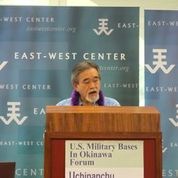
Keynote speaker, Lt. General Wallace Gregson Ret., former commander, US Marine Forces Pacific, explains how Okinawa’s geography has shaped its history and present day situation.  The speech was given at the East-Weste Center symposium, Uchinanchu Talk Story III, March 10, 2013.

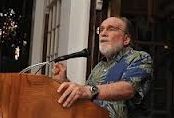
Gen. Wallace "Chip" Gregson delivering his speech on 10 March 2013.

Lt. Gen. Wallace “Chip” Gregson (Ret.).

To hear Gen. Gregson’s speech visit here: http://www.youtube.com/watch?v=n_9VjXP9yUs

UTS III — Welcome Message by John Tasato


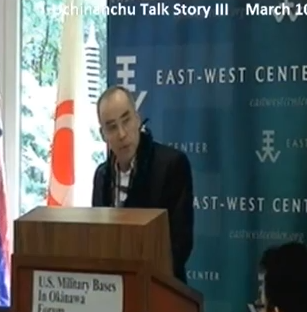
WUB Hawaii President John Tasato welcomes Uchinanchu Talk Story III.

WUB Hawaii President John Tasato welcomes Uchinanchu Talk Story III.

Aloha!  Haisai!

We just completed the successful Uchinanchu Talk Story III “U.S. Bases in Okinawa Forum.”  The conference was held at the East-West Center on March 10.  The purpose of the conference was not to make policy, nor to make a statement, but to learn more about a complex issue and just as importantly to ask questions.

We were honored to have Hawaii Governor Neil Abercrombie and Lt. General Wallace “Chip” Gregson, (Ret.), former Commanding General US Marine Force Pacific (MARFORPAC) as our keynote speakers.  In light of the high level of interest at the conference and the need to keep the conversation going we have provided a link to Gov. Abercrombie’s speech and a comment section where you are invited to voice your opinion on the issue.  We ask that you be civil and thoughtful in your comment speaking to the issue and refraining from personal attacks.

WUB Hawaii is proud to be partners with Akisamiyo-! and the East-West Center.  It is through partnering together that we will strengthen our community locally and around the world.

John Y. Tasato
President, WUB Hawaii